
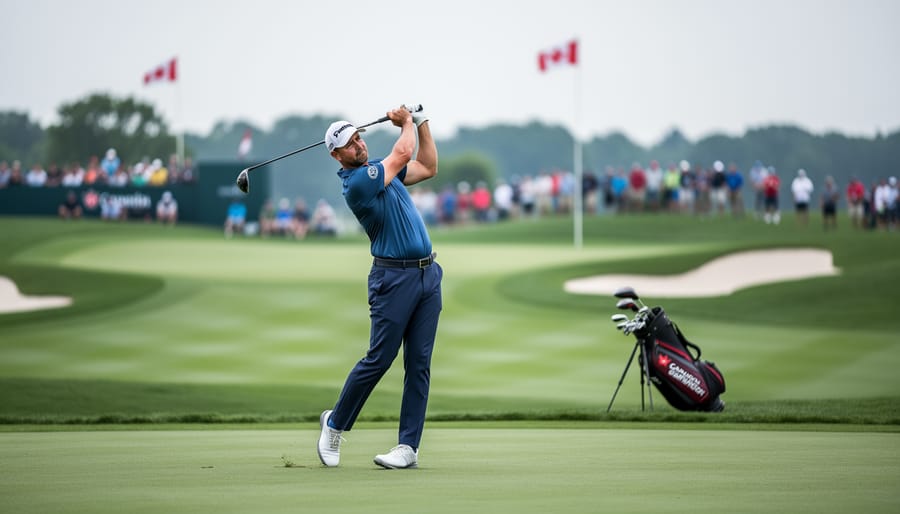
Jimmy Stanger’s swing caught the golf world’s attention at the 2026 RBC Canadian Open, where he tied for the lead and finished fourth after missing four consecutive cuts. What makes his technique particularly instructive for golfers at any level is its simplicity and consistency under pressure, especially visible in his precision on demanding shots like the 223-yard seventh hole, where he landed just under seven feet from the pin in the final round.
Stanger represents something every club golfer can relate to: finding your rhythm after a rough patch. His recent performance wasn’t about overhauling his fundamentals or chasing the latest swing trends. Instead, it showcased the power of trusting a repeatable, straightforward approach when the stakes are high. For those of us working to improve our game without getting lost in complicated mechanics, that’s genuinely encouraging news.
The beauty of studying Stanger’s swing lies in its accessibility. While tour professionals often display athletic moves that seem impossible to recreate on a Saturday morning, the core principles behind his consistency translate beautifully to weekend rounds. Whether you’re playing with family, meeting business contacts for a friendly match, or simply trying to break your personal best, understanding what keeps a player steady through both slumps and breakthroughs offers practical lessons for building a more reliable game. Let’s break down what makes his approach work and how you can apply those same concepts to lower your scores this season.
Who Is Jimmy Stanger?
Jimmy Stanger isn’t a household name in professional golf, but that’s changing fast. The Minnesota native turned heads in June 2026 with a clutch performance at the RBC Canadian Open, where he tied for the lead on the final day and ultimately finished fourth. That result marked a dramatic turnaround after he’d missed four consecutive cuts, a stretch that tests any player’s confidence and resolve.
Stanger’s RBC Canadian Open run showcased the mental toughness that separates good players from great ones. On the final round, while tied for the lead, he hit a precise tee shot on the 223-yard, par-3 seventh hole that landed 6 feet 11 inches from the pin. That kind of precision under pressure doesn’t happen by accident.
Like many pros, Stanger’s path to the PGA Tour required persistence and steady improvement. He’s a player who works on his craft without fanfare, focusing on fundamentals and course management rather than flashy power. His swing reflects that approach: repeatable, reliable, and built for consistency rather than highlight reels.
What makes his story particularly relevant for recreational golfers is how he bounced back from adversity. Four missed cuts could easily derail a player’s season, but Stanger regrouped and delivered when it mattered most. That resilience, paired with a swing built on solid fundamentals, offers valuable lessons for golfers at every level who face their own challenges on the course.
Breaking Down the Jimmy Stanger Golf Swing
The Setup and Stance

A reliable golf swing starts before you ever move the club, and Stanger’s setup demonstrates why fundamentals matter. Watch footage from his 2026 RBC Canadian Open performance and you’ll notice a deliberate, athletic stance that sets the stage for everything that follows.
Stanger positions his feet roughly shoulder-width apart with slight knee flex, creating a stable base that allows for effective weight transfer through impact. His spine angle tilts forward from the hips rather than rounding from the lower back, a detail that helps maintain posture throughout the swing. The ball position varies by club, but he keeps his hands slightly ahead of the ball at address, promoting a clean strike.
What makes this setup work is its repeatability. Stanger doesn’t contort himself into an extreme position that requires perfect timing to execute. Instead, he builds a foundation that feels natural and balanced, the kind of setup you can reproduce on the first tee and the eighteenth green. For recreational golfers, this consistency in the address position often matters more than any single swing thought or tip.
Tempo and Rhythm
Tempo and rhythm separate good ball-strikers from consistent players who perform when it matters. Stanger’s swing demonstrates this principle beautifully, his measured pace never wavers, even when tied for the lead on a tournament Sunday. Watch any footage from the 2026 RBC Canadian Open, and you’ll notice he takes the same deliberate backswing whether hitting his opening tee shot or addressing that pressure-packed par-3 seventh with everything on the line.
This steadiness comes from committing to a repeatable timing pattern. Stanger doesn’t swing faster when nerves spike or slow down when doubt creeps in. His tempo remains unchanged because he’s trained his body to move at one speed, much like how a single-plane swing simplifies mechanics through consistency. The lesson for recreational golfers? Pick a comfortable swing speed you can replicate on the range, then protect it fiercely during rounds, especially when standing over a shot that matters.
The Follow-Through

Stanger’s follow-through demonstrates a principle that many recreational golfers overlook: the swing isn’t finished at impact. His recent performances show what happens when you commit fully through the ball rather than decelerating or cutting the motion short. At the 2026 RBC Canadian Open, his confident finish position was evident even on precise approach shots like the one at the seventh hole that landed within seven feet of the pin. A complete follow-through ensures energy transfers efficiently through impact, promoting both distance and directional control. Notice how proper wrist hinge earlier in the swing sets up a natural release and balanced finish. When you hold your finish position long enough to watch the ball land, you’re reinforcing the swing path and rhythm that got you there.
Pressure Performance: Lessons from the RBC Canadian Open

Jimmy Stanger’s fourth-place finish at the 2026 RBC Canadian Open wasn’t just a strong tournament result, it was a masterclass in handling pressure when it matters most. After missing four consecutive cuts, Stanger found himself tied for the lead during the final round on June 14, facing a moment that could either validate his hard work or add another setback to a difficult stretch.
The defining shot came on the seventh hole, a demanding 223-yard par-3 where precision matters more than power. Standing on the tee box while tied for the lead, Stanger committed to his swing and launched his tee shot onto the right green, landing just 6 feet 11 inches from the pin. That shot showcased more than technical skill, it revealed a golfer who could trust his mechanics when the stakes were highest.
What makes this performance particularly instructive is the context. Stanger wasn’t riding momentum from recent success. He was battling to rebuild confidence after a stretch where nothing clicked. Yet when the leaderboard pressure intensified, he didn’t overswing or second-guess his approach. He executed the same fundamentals he’d been working on, proving that a sound swing holds up precisely because it’s repeatable under stress.
The mental aspect here is crucial for every golfer. Pressure doesn’t change the golf swing itself, but it can make you abandon what works. Stanger’s performance demonstrates the value of trusting your preparation. When you’ve grooved a consistent motion through practice, you can lean on it during those moments when your mind wants to interfere.
For recreational players, the lesson isn’t about hitting precise shots from 223 yards. It’s about developing a swing you can trust when you’re standing over a shot that matters to you, whether that’s a tricky approach with your league team watching or a crucial putt in your club championship. Stanger showed that the golfers who perform under pressure aren’t necessarily the most talented; they’re the ones who’ve built enough consistency to rely on their fundamentals when it counts.
What Recreational Golfers Can Learn from Stanger’s Swing
The beauty of Jimmy Stanger’s recent success is that the fundamentals underpinning his swing are accessible to golfers at every level. You don’t need tour-level athleticism to benefit from the principles that helped him navigate pressure at the 2026 RBC Canadian Open. Here’s what you can take to the practice range at Cornerstone starting this week.
Focus on setup consistency first. Stanger’s ability to hit precise shots under pressure, like that tee shot to 6 feet 11 inches on the seventh hole while tied for the lead, starts with a reliable foundation. Check your stance width, ball position, and alignment before every swing. Take a photo of your address position from down the line, then compare it shot to shot. When your setup varies, your results will too.
Develop a pre-shot routine you trust. Recreational golfers often rush, especially when playing with friends or in club events. Stanger’s composure during his comeback performance demonstrates the value of a repeatable process. Pick two or three specific steps, maybe a practice swing, a deep breath, and a target check, and use them every time. This ritual quiets the mental chatter and shifts your focus to execution rather than outcome.
Practice these drills to build Stanger-inspired fundamentals:
- Alignment stick drill: Place a stick along your target line and another across your toes. Hit 10 balls focusing solely on matching these references, ignoring distance. This trains the setup consistency that supports everything else.
- Tempo swing with a metronome: Set a metronome app to 60 beats per minute. Take the club back on one beat, through on the next. This builds the smooth rhythm Stanger maintains even when stakes are high.
- Finish-and-hold drill: After each shot, hold your follow-through for three seconds with weight fully transferred to your front foot. This trains balance and commitment through impact.
Between drills, incorporate review games that challenge your course management and mental approach. These activities help translate range work into on-course performance by simulating pressure situations in a fun, community-focused environment.
The lesson from Stanger’s breakthrough isn’t that you need to overhaul your swing. It’s that mastering simple fundamentals and staying composed when it matters produces results. Work on one element at a time, get feedback from Cornerstone’s instructors, and give yourself permission to improve gradually. That’s how lasting change happens.
Developing Your Own Consistent Swing at Cornerstone
Jimmy Stanger’s performance at the 2026 RBC Canadian Open proves that breakthroughs happen when talent meets preparation and the right environment. At Cornerstone Golf Club, we’ve built exactly that kind of environment for golfers at every stage of their journey.
Our PGA-certified instructors work with members one-on-one to develop fundamentals that hold up under pressure. Whether you’re working on your setup, refining your tempo, or trying to gain consistency with your driver, personalized instruction tailored to your goals makes the difference. Many members start with a swing assessment that identifies exactly where small adjustments can yield the biggest improvements.
The practice facilities at Cornerstone give you space to put those lessons into action. Our driving range, short game area, and putting greens let you work on different aspects of your game in a relaxed setting. Consistency comes from repetition, and having quality practice space close to home removes the barriers that keep many golfers from improving.
What truly sets Cornerstone apart is the community. You’ll find playing partners who share your goals, friendly competition that pushes you to get better, and a welcoming atmosphere where asking questions never feels awkward. Golf improvement isn’t a solo journey. The encouragement and camaraderie you’ll find here mirror the support systems that help professionals like Stanger stay focused through rough patches and capitalize when opportunity arrives.
Jimmy Stanger’s breakthrough at the 2026 RBC Canadian Open reminds us that even professional golfers face struggles and comebacks. His journey from missing four consecutive cuts to finishing fourth in Canada shows what’s possible when you stick with the fundamentals and keep working on your game.
The truth is, your swing doesn’t need to look exactly like Stanger’s to be effective. What matters is finding consistency through proper setup, maintaining rhythm under pressure, and completing each swing with commitment. These principles work whether you’re playing a casual Saturday round or competing in your club championship.
At Cornerstone, you’ll find the practice facilities, qualified instructors, and supportive community to help you develop a swing that works for your game. Our members represent every skill level, and everyone shares the same goal: enjoying golf while getting better at it.
Your golf journey is uniquely yours. Focus on the fundamentals, practice with purpose, and remember that improvement happens one swing at a time. The next time you step onto the course, you’ll have the tools and confidence to play your best golf.